Friday, December 19, 2008

Friends & Backstabbers


"The best mirror is an old friend"... unless that friend is Cassius. In which case, I'd ask someone else.

We all do this: Something happens and you question how you react to it. Am I being fair? Should I be feeling this way? Is this a good idea? And so, we go to our friends. Best friends are called that for a reason; they are the best at being honest when no one else will. They tell us the truth about our own behavior. They are our mirrors.

" And since you know you cannot see yourself so well as by reflection, I, your glass, will modestly discover to yourself That of yourself which you yet know not of," says Cassius.

TRANSLATION: Everyone knows that you can never really see how you're acting. I'll be your mirror and tell you honestly what I see in you.

Big lie! Cassius is going to say he sees that Brutus is upset about Caesar being offered the crown - that's true - but then he spins it to make Brutus feel as though he, Brutus, has been considering assassination from the being! Poor, poor Brutus. Remember his tragic flaw? Trust. He assumes everyone is as trustworthy and honorable as he is. Can you imagine what your life would be like if you trusted everything everyone told you? Yikes. My guess is you would be horribly taken advatange of. Shakespeare sure is critical of human nature, huh?

And lastly, how does this connect to my life? Well, the image for this post is actually a greeting card I designed. I've told many of you that my hobby is crafting and creating greeting cards. This one is inspired by the artwork of Jack Vettriano - a fellow Scottish native. And if you're wondering how passionate I am about greetings cards, let's just say this is Design #612.

QUESTION: Is the bottom line always about getting what we want?

Thursday, December 11, 2008

These are a Few of My Favorite Things...

I graduated from college in 2005 - which of course feels like a decade ago to me now. To any New Englander or Sox fan, you know this year. It was the year. September and October of my senior year ('04) was spent staying up to watch the Red Sox inch their way into the play offs. By the time the Sox came back to win four straight against the Yankees and advance to the World Series the entire UNH campus - professors included - were totally sleep deprived. As graduation came around in May the class of 2005 was elated to here that Tom Werner would be speaking at our graduation. Tom Werner was the Chairman of the Boston Red Sox.

On graduation day I sat with anticipation among my fellow classmates as we waited to hear from the man who had delivered. We had carried the burden of our forefathers - passionately watching the Sox lose year after year - until now. As Tom Werner got up to speak and donned a Red Sox cap, we all relaxed a little. The future couldn't be that scary - the Sox had one the World Series! And yet it wasn't until the end of his speech that he connected with me personally.
While organizing some school files, I came across a copy of his speech. And I copy it below for your enjoyment:

"Before closing, I wanted you to know I've been reading Shakespeare of late. The great English playwright is always someone to go to for insight. Now, before this year, I had the general impression that baseball is a little over a hundred and fifty years old , and that Abner Doubleday had invented it. Imagine my surprise to know Shakespeare was a great baseball fan and it was he who first wrote about baseball.
For example, in Anthony & Cleopatra, he wrote: "My arm is sore."

In Macbeth: "Fair is foul and foul is fair."

Taming of the Shrew: "You may go walk."

In Hamlet: "A hit, a very palpable hit!"

In Henry V: "And so I shall catch the fly."

In Julius Caesar: "O Hateful Error."

In Henry VIII: "You have scarce time to steal."

And finally in Romeo and Juliet: "I have no joy in this contract."


...You all can guess how the English Teaching Major section erupted into large cheers of applause and a standing ovation.

Saturday, December 6, 2008

Layers of Meaning

Shrek: Ogres are like onions.
Donkey: They stink?
Shrek: Yes. No.
Donkey: Oh, they make you cry.
Shrek: NO. Layers. Onions have layers. Ogres have layers. Onions have layers. You get it? We both have layers.

Now, I would never compare Shakespeare to an ogre but someone's previous comment about Shakespeare's language having many layers reminded me of this scene from Shrek.
Shakespeare's plays are like onions. Every time you read a play you have to peel back layer after layer of meaning, whether it be uncovering sonnets or understanding inappropriate jokes. This is why I think some people have a tough time with Shakespeare (the de-layering takes too long. Just say what you want to say!) and yet at the same time I think this is why some people, like me, become addicted to Shakespeare; uncovering the layers is like a game! And once you understand it you feel as though you're on the inside of some joke that no one else gets, which is always a good feeling.

As for Much Ado About Nothing there are three new components I have unlayered this year while reading with my four classes:
1. Claudio and Hero are both referred to as oranges. Beatrice describes Claudio's grumpy yet civil personality at the party to be like an orange. She plays on the word civil meaning both its literal meaning - polite - and referencing Seville, Spain known for an orange that is both sweet and sour: polite and grumpy. Later on, Claudio refers to Hero at the wedding scene when he believes she has cheated on him and yells at Leonato "give not this rotten orange to your friend!"

2. Benedick and Beatrice's friends both use fish imagery when describing how they will trick each of them into falling in love with the other. Claudio says, "Bait the hook well this fish will bite!" If you rearrange the word order I can easily see someone saying this today, 400 years later. Later on Ursula says of Beatrice, "The pleasant'st angling is to see the fish... greedily devour the trecherous bait." In each instance the bait is the lie Benedick and Beatrice overhear their friends gossiping about - that they are both madly in love with one another.

3. Shakespeare has a motif of illness running through the play... Its EVERYWHERE! One of my poor classes had to sit through a whole period of this: everytime a character mentioned a word that had to do with illness I would shout it out, "suffer!" "cure!" "restore you to health" "are you well?" It went on...and on... and ON. Now, why would Shakespeare do this? After much thought my guess is that he's trying to reinforce the idea of love sickness - that love causes one's behavior to change so rapidly that it is as if the person has been taken ill.
QUESTION: Name a book or movie you have seen that upon the 2nd or 3rd reading/viewing you noticed something that you had not before.

Tuesday, December 2, 2008

Shakespeare in Love

I have already told this story in class but I will repeat it here as it leads into the second half of my post. A few years ago two of my good friends became engaged and on Zack's ring, Shannon had engraved: IV. iii. 288-289. The act, scene and line numbers are in reference to Much Ado About Nothing when Beatrice proclaims to Benedick "I love you with so much of my heart that none is left to protest." Beatrice loves Benedick so entirely that she will no longer pretend she does not or hold back; she will love Benedick completely. How sweet, right?

Now, my older sister has become engaged and as her Maid of Honor she has asked me to keep my eyes peeled for possible readings for the wedding ceremony. Her love and knowledge of Shakespeare is concentrated on Romeo and Juliet. I suggested she use the scene when Romeo and Juliet first meet which is actually written as a sonnet. Notice the three stanzas of four lines with the rhyme scheme A B A B finishing with a rhyming couplet:

ROMEO: If I profane with my unworthiest hand
This holy shrine, the gentle fine is this:
My lips, two blushing pilgrims, ready stand
To smooth that rough touch with a tender kiss.

JULIET: Good pilgrim, you do wrong your hand too much,
Which mannerly devotion shows in this;
For saints have hands that pilgrims' hands do touch,
And palm to palm is holy palmers' kiss.

ROMEO Have not saints lips, and holy palmers too?
JULIET Ay, pilgrim, lips that they must use in prayer.
ROMEO O, then, dear saint, let lips do what hands do;

They pray, grant thou, lest faith turn to despair.

JULIET Saints do not move, though grant for prayers' sake.
ROMEO Then move not, while my prayer's effect I take.


Clever, huh? Remember how this love-at-first-sight-now-I-can-speak-in-sonnets happens to Beatrice when she finds out Benedick loves her?

What fire is in mine ears? Can this be true?
Stand I condemn'd for pride and scorn so much?
Contempt, farewell! and maiden pride, adieu!
No glory lives behind the back of such.

And, Benedick, love on; I will requite thee,
Taming my wild heart to thy loving hand:
If thou dost love, my kindness shall incite thee
To bind our loves up in a holy band;

For others say thou dost deserve, and I
Believe it better than reportingly.

And that "holy band" she talks about - she means a wedding ring!

QUESTION: Do you think when Shakespeare has his characters speak in sonnet form he is showing the strength of love or making fun of them?

Sunday, November 23, 2008

The Secret Life of Holiday Gift Giving

This year I have focused on going green and being more aware of the world around me. As the holiday season slowly approaches I have started to think about my own holiday shopping. This year I want to "think green and globally" when making purchases. Recently, I found The Heifer Foundation . With donations starting at just $10 you can help purchase livestock for people in need. One of the options was honey bees, and of course, I instantly thought of Secret Life of Bees by Sue Monk Kidd our summer reading novel! So to thank mom for buying you a copy of the novel, you could make a bee donation!
Beyond bees you can donate chicks (also great for moms), ducks, bunnies, cows, llamas, and more. I donated trees in my future brother in law's name welcoming him to our family tree. In the mail you receive a gift card to give to your recipient. The gift card is designed by one of my favorite children's artists Tomie De Paola. A great idea is to buy a small stuffed animal of the animal you donated.

QUESTION: What ideas do you have for "thinking green and globally" this holiday season?

Friday, November 21, 2008

Top 3 Most Misspelled Words

1. Definitely
2. Beginning
3. Woman

These are the three words I see most commonly misspelled in my students' work. This post is not so much a connection as a query: Why? Why are these three words so impossible to spell? Let us consider each one:

Definitely makes sense to misspell because we pronounce the word 'definately' and so it follows that 'definately' is how I see it misspelled most often. Sometimes it is spelled 'defiantly' which always makes me chuckle because defiantly has its own definition and can sometimes cause a normal sentence to suddenly become rather funny.

Now beginning, it seems to me, is a word that students most commonly want to shorten to 'begging.' The second 'n' is also frequently forgotten, 'begining.'

The third most misspelled word is not necessarily a misspelling as an inappropriate pluralization of the word. Woman implies one, while women implies many. I am a woman. My mother, sister and I are women. I can not begin to count the number of times woman/women are misused particularly on in-class essays.

And because no one is a perfect speller...

My own most commonly misspelled words:
1. separate
2. piece
3. Effect/Affect

I often write 'seperate'... I remember this now by saying "there's a rat in separate." Piece - well, I just misspelled it as I was typing this. Finally, the difference between effect/affect still alludes me sometimes.

Question: What are your 3 most commonly misspelled words?

Wednesday, November 19, 2008

Using Words as Fists

" Freestyle rap battles: opponents using words as fists. The words are improvised as quickly as they are spit. They rhyme. They are to a beat. And they are aimed directly at the specific weaknesses of the opponent.” - The director of 8 Mile, Curtis Hanson

Wit Combats were verbal duels that playwrights would partake in while at taverns in Elizabethan England. In front of crowds they would verbally "punch" one another with insult after insult. Speeding ahead 400 years I think of MTV's show Yomama and a movie that was on tv just last week 8 Mile starring rapper Eminem. Here is a clip of the movie director describing rap battles which are essentially wit combats of today. Note: this movie is rated R.

We do have one little piece of wordplay that has survived between two playwrights. Not necessarily insults but certainly playing off of one another's words. After watching the movie director's clip you can almost hear the rap rhythm of today come through in their words:

Jonson: If, but stage actors, all the world displays,
Where shall we find spectators of their plays?

Shakespeare: Little, or much, of what we see, we do;
We are all both actors and spectators, too.


Question: Are rap battles only hurtful or could we see them as beneficial?

How I Fell in Love with Shakespeare


This month my sophomores have started reading Much Ado About Nothing by William Shakespeare. I introduced this to my students by singing, "It's the most wonderful time of the year!" Many of them rolled their eyes - which I am used to - and let out groans of displeasure. So I feel there is something here that I must clear up: I have not always been in love with Shakespeare. It is not as if I was reciting Shakespeare in kindergarten, far from it. No, I did not fall in love with him until much later in my educational career when I finally understood him. I guess you could say we had been "dating" since high schoo,l but I just did not get him. He was confusing, melodramatic, and old. Really, really old. What made it worse was that all my teachers seemed to think he was the world's greatest writer. I must have been missing something...


Another common misconception of my students is that I got straight As in high school. Not true. I was a teenager that worked very hard for Bs (*Note: I did not use an apostrophe there because then 'B' would be owning something: B's new blog). The reason why I mention this is that when I finally got Shakespeare it was like winning the Superbowl. It was exhilirating and unbelievable. I was so proud of myself - I mean - I had gotten Shakespeare! From then on I chipped away at his plays, with the help of a favorite professor, and slowly but surely began to uncover what so many others had already realized: the man was a genius. He was witty, sarcastic, inappropriate, romantic, evil, hopeful and cynical all at the same time, in the same play. And not just once but dozens of times, in dozens of different kinds of plays! And everything he said then, all the topics he covered, are still applicable today: love, friendship, betrayal, jealousy, scandal and so on.


My goal: to help my students get Shakespeare; to help them have that feeling of pride like I did when they are able to explain a quotation that was written 400 years ago because they truly get it. And maybe they will not fall in love, but at least appreciate why I did.


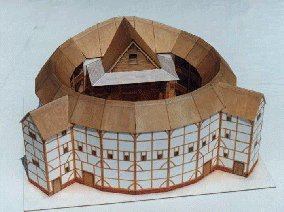
Hopefully this helps explain the Globe Theatre model, the Shakespearean Insult Gum and the Much Ado About Nothings.

Question: What has your Shakespeare experience been like?

Defining English

English is about communicating ideas and feelings; it is about understanding what makes people tick; and it is about trying to better readers through journeys of personal enlightenment and tolerance.

Question: What is the purpose of English class?